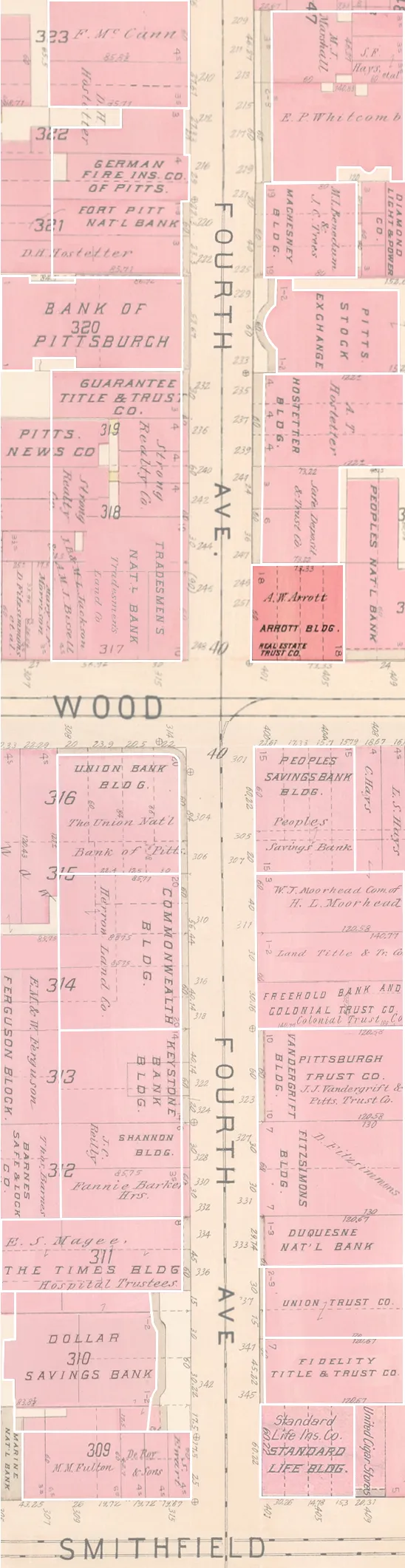


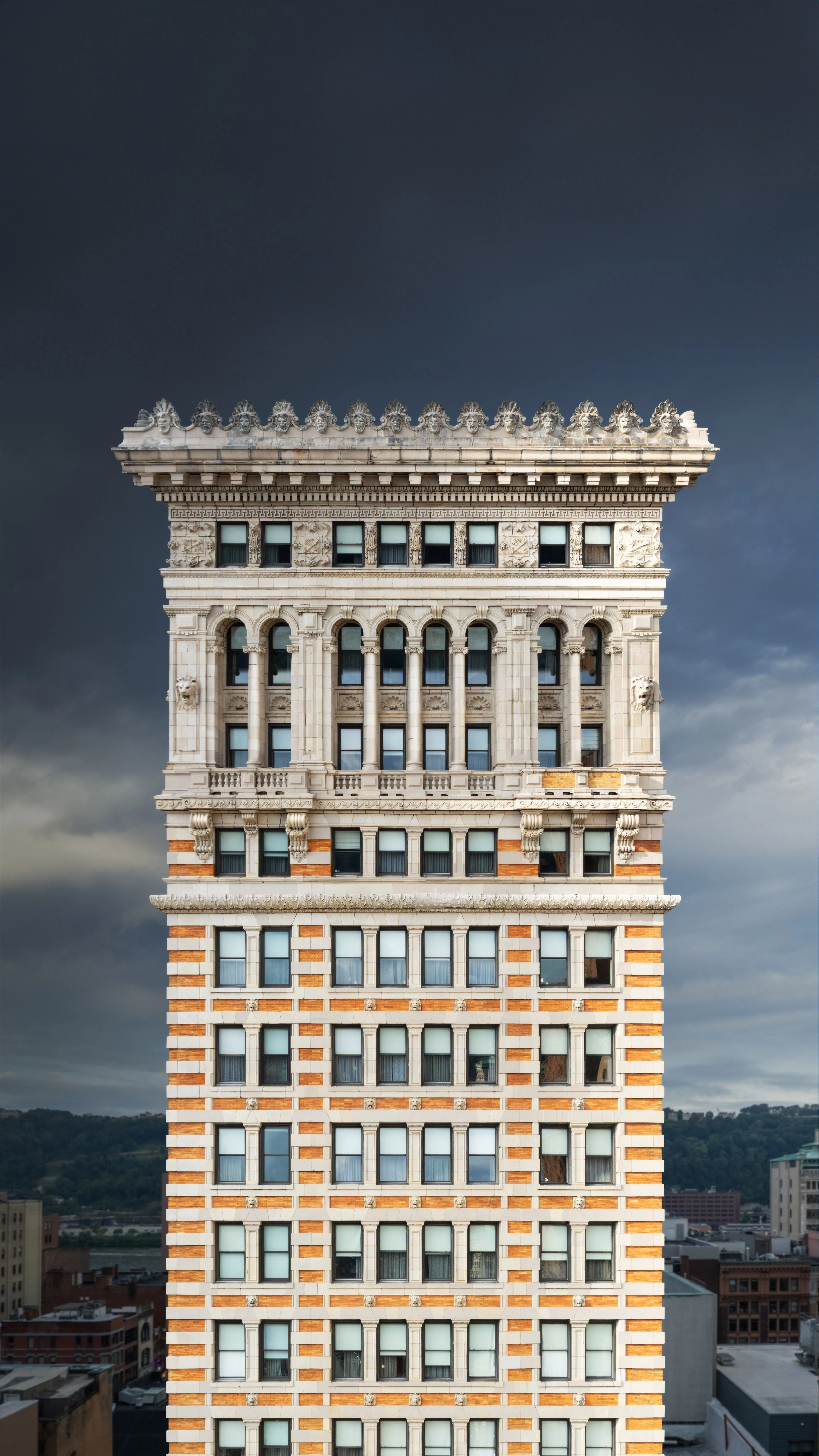
Arrott Building
A tour de force of contrasting brick and terracotta stripes, narrow Venetian-style arched colonnades and false balconies, and a cornice of howling faces, this showpiece skyscraper is by Frederick Osterling, the prolific Pittsburgh architect who contributed three towers and a sprawling, triple-faced bank to Fourth Avenue, the former "Wall Street of Pittsburgh."
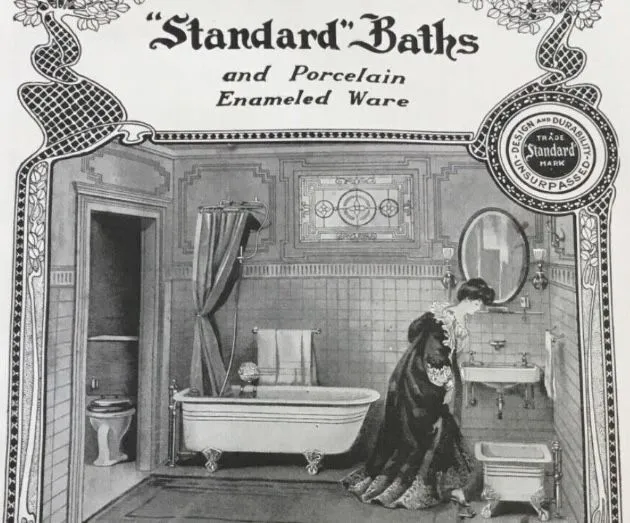
The namesake of the building, James Arrott, made his fortune manufacturing bathtubs. The company he founded, Standard Manufacturing, is still in business today as American Standard. Kings of England and Italy were among the contented customers who soaked in Arrott’s tubs, the company claimed in its catalogs. It had offices here for a time, then moved across town to quarters with a large bathroom showroom.
Now converted into a boutique hotel, with an exquisite lobby of marble and mosaic trim that has been admirably preserved, the building was not always appreciated. In the 1950s, this skyscraper was so far out of fashion that it was snapped up on the cheap by a sandwich shop owner.
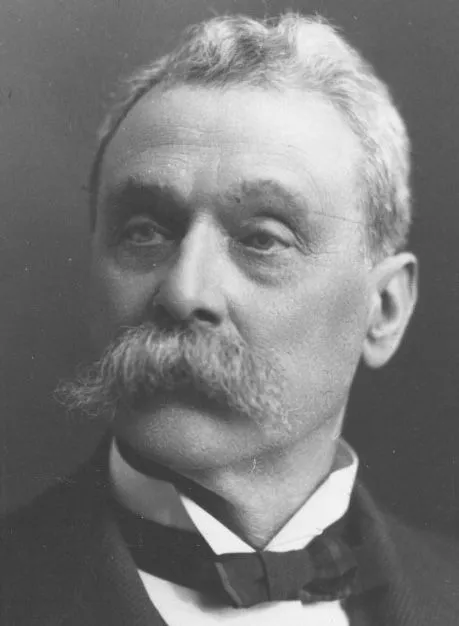
James Arrott
An Irish immigrant from County Donegal, James Arrott arrived in Pittsburgh in 1859 and started a fire insurance business. One of his clients was a local foundry that manufactured enameled hollowware: iron pots and pans with a shiny porcelain glaze.
The foundry was destroyed in an 1872 fire. The owners rebuilt but then sold it to Arrott and his partners, who broadened its product line to include pumps and other plumbing supplies, and eventually bathtubs. The shiny white tubs were a novelty then, with the recent introduction of indoor plumbing and sewer systems. By 1899, with his factory producing 200 tubs a day, Arrott orchestrated a merger with competitors to form a “bathtub trust,” and commissioned this skyscraper.
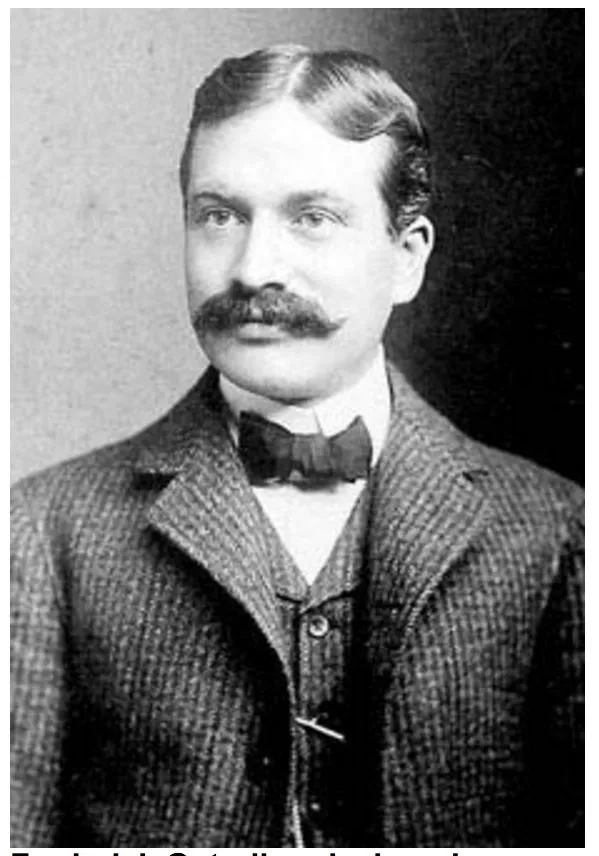
Frederick Osterling
At the age of 19, Frederick Osterling designed a house for his father’s lumber business partner. Then after a year studying architecture in Europe, he set up a solo practice in Pittsburgh, and rapidly found success.
Before he turned 30, Osterling had secured several big jobs, including offices for Westinghouse Air Brake and Bell Telephone, and the first steel-framed skyscraper in Pittsburgh, the Times Building. He built impressive homes for Henry J. Heinz and Charles Schwab, as well as schools, libraries, courthouses, and more skyscrapers.
Perhaps his most widely admired work is the Gothic revival Union Trust Building on Grant Street. That was for Henry Clay Frick, whose East End mansion Osterling also remodeled.
PARTNER